
Polyether Amine (PEA) vs Petroleum Solvents
PEA vs petroleum solvents is the key comparison behind most modern fuel system cleaners. Polyether amine (PEA) is a true detergent designed to survive combustion temperatures and strip hard carbon from injectors and combustion chambers, while petroleum-based solvents mainly dissolve soft varnish and moisture in the cooler parts of the fuel system. This article explains how each chemistry works, where each one fails—especially in GDI engines—and when it makes sense to use a deep-cleaning PEA product versus a maintenance-grade solvent blend.
Active detergents—specifically Polyether Amine (PEA)—are engineered to survive extreme heat and remove hard carbon inside combustion chambers. Petroleum-based solvents—such as naphtha, IPA, or mineral spirits—are better suited to soft varnish and moisture displacement.
This article clearly explains PEA vs petroleum solvents, including how each works, their thermal limitations, and why PEA-based cleaners are the mandatory choice for modern vehicles.
For readers exploring related chemistry topics, see our article to detergents and deposit control additives.
Table Of Contents
What Is PEA (Polyether Amine)?
PEA is a synthetic, nitrogen-containing polymer designed with two functional ends:
- Polar Head: Bonds to carbon deposits and metal surfaces.
- Non‑Polar Tail: Dissolves into the fuel, dragging the deposit off the surface to be burned away.
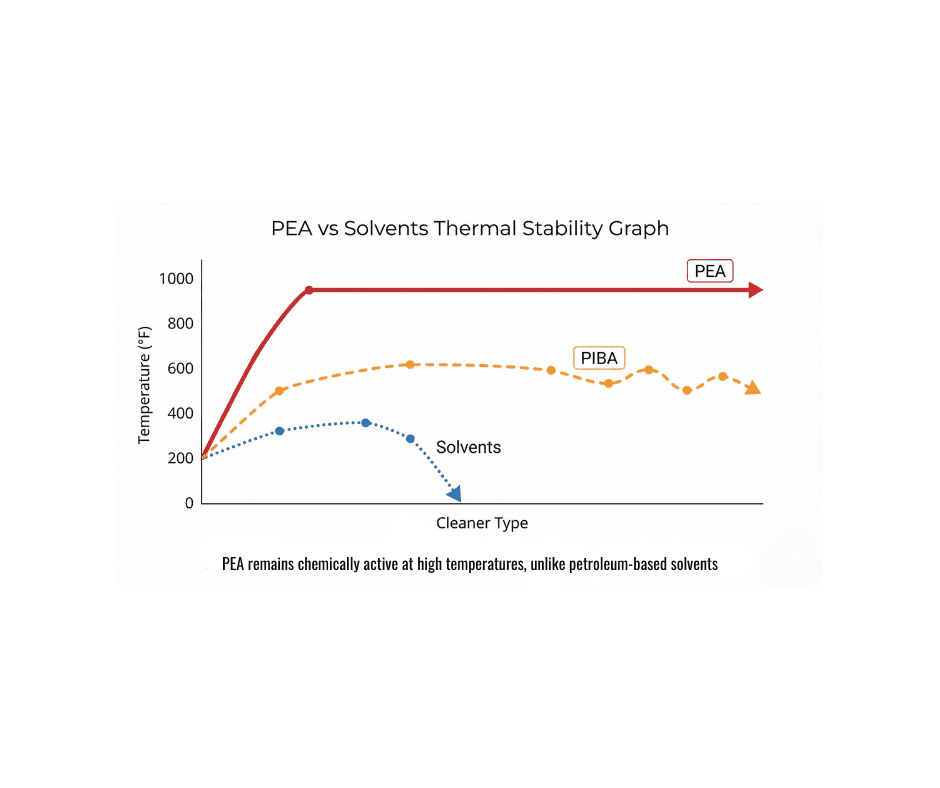
PEA does not simply “dissolve” carbon like a solvent—it chemically detaches hard carbon from metal surfaces. This makes it uniquely effective inside combustion chambers where temperatures exceed 900°F (480°C). For readers unfamiliar with how base-stock chemistry affects deposit formation, see our overview of synthetic base oils
What Are Petroleum-Based Solvents?
Common solvent ingredients include:
- Naphtha
- Kerosene
- Mineral spirits
- Isopropyl alcohol (IPA)
These hydrocarbons are excellent at dissolving soft varnish, gum, and moisture, but the molecules volatilize (burn off) long before they reach the combustion chamber. As a result, they are chemically incapable of cleaning high‑heat components like piston tops or GDI injector tips.
Comparison: PEA vs PIBA vs Petroleum Solvents
PIBA (Polyisobutene Amine) is widely used in mid-range “injector cleaners.” It is suitable for port-injected (PFI) engines but chemically insufficient for GDI carbon removal.
| Feature | PEA (Polyether Amine) | PIBA (Polyisobutene Amine) | Petroleum Solvents |
|---|---|---|---|
|
Best For
|
GDI injectors, piston tops, combustion chambers
|
Port injectors, intake valves
|
Carburetors, soft varnish, moisture removal
|
|
Thermal Stability
|
High – survives injector tip heat soak
|
Medium – degrades in chamber temps
|
Low – evaporates/burns instantly
|
|
Carbon Removal
|
Removes hard, baked‑on carbon
|
Removes soft deposits
|
Removes gum and wet sludge
|
|
Residue
|
Burns clean (Zero ash)
|
May leave trace residue
|
Can leave oily residue
|
|
Cost
|
$$$ (Premium)
|
$$ (Mid‑Range)
|
$ (Low Cost)
|
Fuel detergency also interacts with viscosity behavior and deposit control, discussed further in our viscosity fundamentals guide
Note: High-quality PEA products—including AMSOIL P.i., Chevron Techron, and BG 44K—often contain light solvents as “carriers.” The solvent helps the fluid flow into the tank; the PEA does the actual cleaning.
Independent studies from SAE International describe PEA as one of the most thermally stable detergent chemistries available for gasoline engines.
AMSOIL P.i.
Some manufacturers publish detailed performance data for their high-PEA formulations. One example is AMSOIL P.i., a deep-cleaning PEA detergent designed for restorative cleaning in modern engines. According to third-party testing, P.i. restored GDI injector flow to 100% and delivered a 14% horsepower increase after one treated tank in a 5.3L GDI engine with over 100,000 miles.
The testing images show significant removal of carbon deposits from injector tips, cylinder head surfaces, and combustion chamber components after a single cleaning cycle. These results align with laboratory expectations of high-activity PEA chemistry in high-temperature environments.
This type of deep cleaner is typically used every 4,000 miles for major deposit removal, while lighter maintenance additives are used between treatments to slow deposit formation.
Popular Brands Analysis
Marketing labels often hide the chemistry. We have analyzed the Safety Data Sheets (SDS) of popular additives to categorize them by their primary active ingredients.
The PEA Heavyweights (Best for GDI)
These products list Polyether Amine (or proprietary variations) as the primary active detergent.
- AMSOIL P.i. (Performance Improver) is a high-strength gasoline detergent that uses a concentrated PEA formulation to remove stubborn injector, valve, and combustion-chamber deposits. According to AMSOIL’s published testing, P.i. can restore up to 14% horsepower in one tank by cleaning hardened deposits in GDI injectors and reducing carbon-related pre-ignition. Testing also showed P.i. returning GDI injector flow to 100% after a single treated tank in a controlled third-party evaluation.
- P.i. is designed for periodic deep-cleaning, typically every 4,000 miles, and is intended for engines with measurable buildup or performance loss. It is safe for catalytic converters, oxygen sensors, capless fuel systems, and E85 fuel.
- Chevron Techron Concentrate Plus: The industry standard. Uses “Techroline” (their patented PEA). It is the approved OEM additive for BMW, GM, and Toyota.
- BG 44K Platinum: A professional-grade mechanic favorite. It has an exceptionally high molar mass of PEA, making it aggressive against heavy carbon.
- Red Line SI-1: Famous among enthusiasts for having one of the highest concentrations of PEA on the market (often 30–50% by volume).2
The Solvent/Oil Blends (Best for Maintenance)
These products rely on Naphtha, Pale Oil, or Isopropyl Alcohol.
- Sea Foam: Primarily Pale Oil, Naphtha, and IPA. Excellent for stabilizing fuel, removing moisture, and cleaning carburetor jets, but lacks the heat resistance for GDI combustion chambers.
- Lucas Fuel Treatment: An oil-based “upper cylinder lubricant.”3 It is excellent for lubricating fuel pumps and injectors in older engines but acts more as a conditioner than a hard-carbon stripper.
- Marvel Mystery Oil: A mineral spirits and chlorinated hydrocarbon blend. Great for lubrication and sludge prevention, but not a high-temp carbon solvent.
- AMSOIL: AMSOIL also offers a maintenance-grade fuel additive (Upper Cylinder Lubricant), which is formulated with lighter detergents and friction modifiers intended for continuous use. This type of product is not a high-PEA deep cleaner; instead, it helps maintain injector cleanliness, reduce wear in the upper cylinder, and provide mild deposit control between periodic PEA treatments.
The GDI Problem
In older Port-Injected (PFI) engines, fuel sprays onto the back of the intake valve, constantly washing it. GDI engines inject fuel directly into the combustion chamber, exposing injector tips to extreme heat and pressure.
The Heat Soak Effect
When a GDI engine is shut off:
- Injector tips remain extremely hot.
- Thin solvent molecules evaporate instantly.
- Residual fuel cooks into hard carbon.
PEA remains stable in liquid form long enough to penetrate and loosen this hardened carbon crust during the “heat soak” period.
Warning: The Intake Valve Limitation
In GDI engines, fuel never touches the intake valves. Therefore, fuel-tank additives cannot clean GDI intake valves.
To clean GDI valves, you must use an aerosol induction cleaner (sprayed through the intake) or physical walnut-shell blasting. This applies to all brands.
5 Signs Your Engine Needs PEA
If you drive a car built after 2012, carbon buildup is a matter of “when,” not “if.” Here are the mechanical symptoms that indicate you need a PEA cycle immediately.
- Cold Start Misfires
If your car stumbles or shakes for the first 30 seconds after starting but smooths out once warm, you likely have carbon buildup on the injector tips. The carbon absorbs the initial fuel spray, causing a lean mixture. PEA can dissolve this “sponge” effect.
Often described as a “super knock,” this sounds like marbles rattling in a can when you accelerate at low RPMs. It is caused by glowing carbon embers on the piston top igniting the fuel too early. PEA cleans the piston tops, eliminating the heat source.
- “Hunting” Idle
If your RPM needle bounces up and down while stopped at a red light, your fuel atomization is likely compromised. Uneven spray patterns from dirty injectors confuse the ECU, causing it to constantly adjust fuel trim.
- Gradual MPG Decline
Carbon doesn’t break an engine overnight; it slowly suffocates efficiency. If you have noticed a 10–15% drop in gas mileage over the last year, your spray pattern is likely degraded.
- Failed Emissions Test (High NOx)
Carbon takes up space in the combustion cylinder, which effectively raises the compression ratio and combustion temperature. Higher temps create more Nitrogen Oxides (NOx). Cleaning the carbon lowers the cylinder temps and can help pass emissions.
Intended Use Cases
When to Use PEA-Based Cleaners
(Examples: AMSOIL P.i., Techron, Gumout Regane, BG 44K)
- Restoration: You have hesitation, rough idle, or lost fuel economy.
- GDI Vehicles: necessary for all modern engines (2012+ typical).
- High Mileage: Vehicles that have not been cleaned in 10,000+ miles.
- Knocking/Pinging: To clean carbon hot spots off piston crowns.
When to Use Petroleum Solvents
(Examples: Sea Foam, Lucas, Marvel Mystery Oil, AMSOIL Upper Cylinder Lubricant)
- Storage: Moisture removal in stored fuel (stabilization).
- Carbureted Engines: Cleaning jets and float bowls in older classics or lawn equipment.
- Light Maintenance: Gentle, low-cost preventative cleaning.
- Upper Cylinder Lube: Lubricating fuel pumps in older diesel or rotary engines.
Safety & Compatibility
Polyether Amine (PEA)
- Safe for injectors, seals, and oxygen sensors.
- Burns cleanly with no ash formation.
- Usage: Use as directed (typically every 3,000–5,000 miles).
- Caution: Excessive use (every tank) may increase fuel dilution in the engine oil.
Petroleum Solvents
- Generally safe in small doses.
- Some aggressive solvent blends (acetone/xylene) can swell rubber components in vintage cars.
- High-alcohol blends can dry out older fuel lines.
Why detergents behave differently under high heat
PEA remains chemically active above 900°F, allowing it to reach combustion-chamber deposits. Petroleum solvents evaporate long before this point, which limits their effectiveness in GDI injector environments.
How injector design affects deposit formation
GDI injectors sit inside the combustion chamber, where fuel pressure, soot formation, and heat soak increase the likelihood of carbon buildup. Port injectors, by contrast, spray fuel onto the valve backs, which naturally washes them.
Why some additives reduce knocking or pre-ignition
Strong detergents remove carbon hotspots that retain heat and raise effective compression. Reducing these hotspots can lower the risk of pre-ignition and carbon-rap behaviors.
Why not all detergents work the same in every engine
Fuel chemistry interacts with injector type, combustion temperature, driving style, and deposit age. Fresh varnish responds well to solvents, while older crystalline carbon requires a true PEA detergent.
Why “one-tank cleanups” vary in effectiveness
Deep-cleaning PEA formulas can deliver measurable results in a single tank, but only if deposits are directly exposed to the fuel stream. Carbon on GDI intake valves cannot be reached this way and requires induction cleaning.
Which One Should You Use?
For modern engines, especially GDI, PEA is the only chemistry proven to remove hard combustion carbon. Solvents are useful for cleaning fuel tanks or carburetor bowls—but they cannot survive combustion temperatures and therefore cannot clean injector tips or piston crowns.
The Strategy:
- Restoration: Use a high-PEA product every oil change (3k–5k miles).
- Maintenance: Use light solvents if you need moisture control or storage stabilization.
- The Label Check: If a product claims to clean injectors but does not list “Polyether Amine” (or proprietary equivalents like Techroline) on the SDS/Label, it is likely a solvent-only formula.
For readers comparing fuel quality, energy content, or octane effects alongside detergent performance, our fuel system calculators and diagnostic tool provide useful reference points.
FAQ
Does PEA damage oxygen sensors or catalytic converters?
No. PEA burns cleanly and is recommended by multiple OEMs (Original Equipment Manufacturers) specifically because it is safe for sensitive emissions equipment.
How often should I use a PEA cleaner?
Most manufacturers recommend intervals of 3,000–5,000 miles (roughly every oil change).
Can I use PEA in a carbureted engine?
Yes. It provides effective cleaning without harming seals or floats, though it is often overkill for simple varnish removal.
Will a PEA tank additive clean GDI intake valves?
No. Intake valves in GDI engines require induction cleaning or walnut blasting.
Which brands contain real PEA?
Based on SDS data, AMSOIL P.i., Chevron Techron, Gumout Regane, and BG 44K all use high-concentration PEA formulations
Powered by LubeGuide.org
Cut Through the Oil Talk. Get the Facts.