
Oil Filter Bypass Mode Plugs Small Oil Journals
The oil filter bypass myth claims that when an oil filter enters bypass mode, unfiltered oil is forced into small oil passages or journals, where it can plug clearances and cause rapid engine damage. A closely related claim suggests that tighter micron oil filters are inherently dangerous because they “plug faster,” triggering bypass events that allegedly send harmful debris into sensitive engine components.
This explanation appears intuitive, but it is mechanically incorrect. Oil filter bypass operation does not redirect contaminants into specific oil passages, nor does it create a condition where small journals are selectively obstructed. In reality, bypass valves exist to prevent oil starvation, and oil passage blockage occurs only under abnormal failure conditions unrelated to normal filtration or bypass behavior.
Understanding how oil flows through an engine, and what a bypass valve actually does, resolves this misconception.
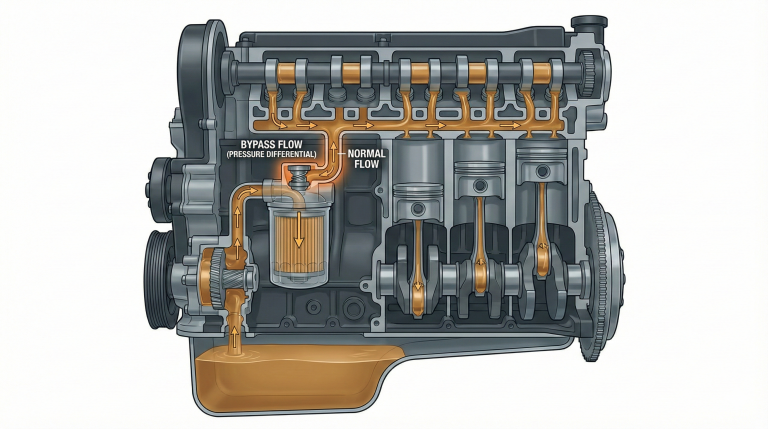
Table Of Contents
What an Oil Filter Bypass Valve Actually Does
An oil filter bypass valve is a pressure-differential safety device. It responds to the pressure drop across the filter media, not to overall oil system pressure and not to downstream demand at the engine.
When oil is cold, highly viscous, or when temporary restriction develops across the filter media, the pressure differential increases. Once this differential exceeds the bypass valve’s calibrated opening point, the valve opens to allow oil to bypass the filter media internally.
Crucially, bypass operation does not interrupt oil flow. Oil continues to move through the lubrication system and into the engine’s oil galleries without delay. The bypass valve exists specifically to ensure that oil delivery is maintained under all operating conditions, even when filtration efficiency is temporarily reduced.
Bypass mode therefore represents a protective operating state, not a failure condition.
Oil Flow Inside an Engine During Bypass Operation
Engine oil follows a consistent hydraulic path regardless of whether the filter is operating in full-flow or bypass mode. Oil is drawn through a pickup screen, pressurized by the oil pump, routed through the filter assembly, and then distributed through internal oil galleries to bearings, journals, and valvetrain components.
When the bypass valve opens, the downstream flow path does not change. Oil still enters the same galleries and reaches the same components in the same proportions dictated by bearing clearances and pressure gradients. The only change is that oil is no longer forced through the filter media before entering the galleries.
There is no mechanism by which bypass operation allows oil to target smaller passages or concentrate debris in specific locations. Hydraulic flow does not sort particles by size, and oil passages are not selectively exposed during bypass events.
Why the “Bypass Plugs Small Journals” Claim Fails
The idea that bypass operation plugs small oil journals fails when particle size and passage geometry are considered together.
Oil passages and galleries are significantly larger than the particles responsible for normal engine wear. Any debris large enough to physically block an oil passage cannot pass through the oil pickup screen or the oil pump. Conversely, particles small enough to circulate through the pump and galleries are also small enough to pass through oil passages without causing blockage.
If oil passages become obstructed, it indicates the presence of abnormal material, such as sludge agglomeration or component debris from internal failure. These conditions exist independently of oil filter bypass operation.
Bypass does not introduce new debris into the system. It simply allows already-circulating oil to continue flowing rather than starving the engine.
Micron Rating and the Plugging Misconception
The claim that smaller micron oil filters plug faster relies on an oversimplified understanding of filtration. Micron rating describes particle capture efficiency at a defined size, but it does not determine how quickly a filter becomes restrictive.
Flow restriction is governed by media surface area, depth loading characteristics, fiber structure, and how contaminants are distributed throughout the media. A lower-micron filter with sufficient surface area and depth can maintain stable flow over long service intervals, while a coarser filter with limited media capacity may restrict flow sooner.
In a healthy engine, contamination generation is gradual and well within the capacity of modern filter designs. Rapid filter restriction occurs only when contamination rates become abnormal, such as during coolant ingress, severe sludge formation, or mechanical breakdown. In these cases, bypass operation is a response to the failure, not its cause.
What Actually Causes Oil Passage Blockage
True oil passage blockage results from chemical or mechanical failure, not from filtration strategy.
Sludge formation from extended neglect or severe oxidation can narrow or obstruct oil galleries. Coolant contamination can create gelatinous deposits that restrict flow. Mechanical failures, such as bearing material delamination or component fracture, can introduce debris far larger than any filter is designed to manage.
When these conditions exist, oil flow degradation is already underway. Filter bypass operation may coincide with these failures, but it does not initiate them
Real Risk Versus Perceived Risk
The most damaging condition for an engine is oil starvation, not brief exposure to unfiltered oil. Bearings depend on continuous oil film formation, and loss of flow causes immediate damage.
Short-duration bypass events, such as those occurring during cold starts, preserve oil delivery during periods of high viscosity and elevated restriction. Wear accumulation is influenced by viscosity control, temperature, load, and operating environment, not by momentary bypass operation.
Immediate engine failure attributed solely to bypass flow is inconsistent with observed engine wear mechanisms and failure analysis.
Oil filter bypass mode does not plug small oil journals or passages. It does not redirect debris, and it does not increase the risk of blockage. Bypass valves exist to maintain uninterrupted oil flow when restriction rises temporarily, protecting engine components from oil starvation.
When oil passages become obstructed, the cause is severe contamination or mechanical failure that predates bypass operation. Understanding this distinction corrects the oil filter bypass myth and restores an accurate model of how engine lubrication systems function.
FAQ
Does oil filter bypass mode block oil passages?
No. Bypass mode allows oil to continue flowing around the filter media. Oil passages and galleries remain unchanged and are not selectively blocked.
Can a tighter oil filter cause engine damage?
Not by itself. Micron rating does not determine restriction or plugging risk. Filter design, media surface area, and contamination levels are far more important factors.
Why do engines have bypass valves at all?
Engines use bypass valves to prevent oil starvation during cold starts or temporary high-restriction conditions, ensuring continuous oil delivery to critical components.
If a filter plugs, is the engine already damaged?
In most cases, yes. Rapid filter restriction indicates abnormal contamination such as sludge, coolant intrusion, or internal mechanical failure rather than normal filtration behavior.
Powered by LubeGuide.org
Cut Through the Oil Talk. Get the Facts.