
The Future of Ultra-Low Viscosity Engine Oils
The shift in automotive lubrication has been drastic. Just two decades ago, 10W-40 was the global standard. Today, 0W-20 is the factory fill for nearly 50% of new vehicles produced globally, with Japanese OEMs already pushing into 0W-16 and 0W-8 territories. This isn’t a random trend; it is a calculated engineering response to strict Corporate Average Fuel Economy (CAFE) standards requiring average fleet efficiency to exceed 49 mpg by 2026.
However, as oil becomes thinner to reduce drag, it edges dangerously close to the limits of physics. Engineers are now battling the fundamental trade-off between efficiency and engine durability. How thin is too thin?
Table Of Contents
What is Ultra-Low Viscosity Engine Oil?
Ultra-low viscosity engine oil is a highly specialized synthetic lubricant, typically graded 0W-16, 0W-8, or lower, engineered to minimize internal hydrodynamic drag and maximize thermal efficiency. These oils utilize advanced friction modifiers and base stocks to maintain essential protective film thickness in modern, tight-tolerance internal combustion and hybrid engines.
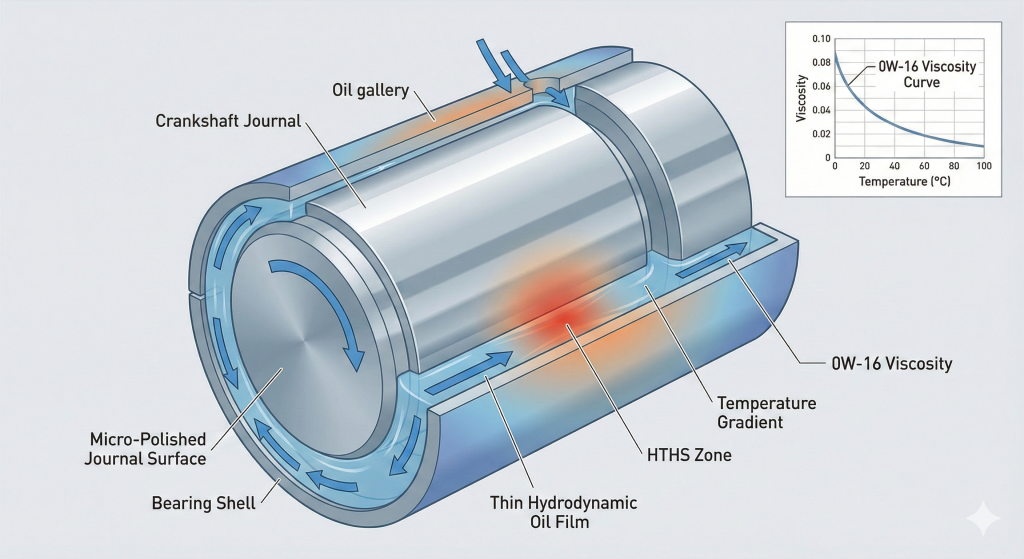
Kinematic vs. HTHS Viscosity
To understand the safety limits of these oils, we must distinguish between two critical metrics:
Kinematic Viscosity (KV100)
How the oil flows at 100°C under gravity. This dictates the “grade” (e.g., the “16” in 0W-16).
The move toward oils like 0W-16 and 0W-8 is not about performance in the traditional sense of horsepower; it is about “parasitic loss reduction.”
- Hydrodynamic Drag: Thicker oil creates resistance against moving parts (pumping losses). Reducing viscosity lowers this resistance, freeing up energy that would otherwise be wasted as heat.
- Cold Start Circulation: Up to 75% of engine wear occurs at startup. Ultra-low viscosity oils flow instantly, pressurizing hydraulic tensioners and variable valve timing (VVT) phasers milliseconds faster than 5W-30.
- Hybrid Synergy: Hybrid engines endure frequent stop-start cycles and often operate at lower oil temperatures (60°C–80°C) where heavier oils would be too viscous to flow efficiently.
High-Temperature High-Shear
The viscosity of the oil as it is being squeezed through bearings at 150°C. This is the number that matters for protection.
If HTHS drops too low, the oil film protecting the crankshaft bearings collapses, leading to metal-on-metal contact.
- 0W-20 Minimum HTHS: 2.6 mPa·s
- 0W-16 Minimum HTHS: 2.3 mPa·s
- 0W-8 Minimum HTHS: 1.7 mPa·s
The drop from 2.6 to 1.7 represents a massive reduction in the safety margin. To survive this, engines require fundamentally different metallurgy.
Tribology & The Stribeck Curve
Lubrication regimes are defined by the Stribeck Curve, which charts friction against viscosity and speed.
- Hydrodynamic Lubrication: The ideal state. The crank floats on a wedge of oil.
- Boundary Lubrication: The danger zone. The oil film is too thin to separate surfaces, and friction spikes.
Ultra-low viscosity oils operate closer to the “mixed” or “boundary” regions of the curve. To prevent catastrophic failure, OEMs employ:
- Micro-polished Journals: Reduces the height of surface asperities (microscopic peaks on the metal).
- DLC (Diamond-Like Carbon) Coatings: Used on piston rings and cam followers to provide a friction coefficient near zero, even when the oil film breaks momentarily.
- Variable Displacement Oil Pumps: These pumps can aggressively alter flow rates to maintain pressure even when the fluid is as thin as water.
0W-16 is Too Thin to Protect an Engine
The Myth: Many enthusiasts believe that 0W-16 or 0W-8 oil is “water” that will inevitably cause rod knock or premature bearing failure because it cannot maintain a film.
The Truth: Viscosity is not an absolute measure of protection; it is a relative measure of clearance. An engine designed for 0W-16 has tighter bearing clearances and different surface finishes than an engine designed for 5W-40.
In a 1990s engine with loose tolerances, 0W-16 would indeed result in pressure loss and failure. However, in a modern engine designed with clearances under 0.001 inches and DLC coatings, 0W-16 provides the exact same hydrodynamic separation that 5W-30 provided in older engines, but with significantly less drag. The oil isn’t “too thin”—the engine is “too precise.”
Is 0W-0 Possible?
Under the current SAE J300 standard, a true “0W-0” is impossible.
- The “0W” refers to cold cranking performance (simulating -35°C).
- The second number (e.g., 20, 16) refers to operating viscosity.
A “0” operating grade would imply zero viscosity, which physically means zero resistance to flow—a property of superfluids, not engine oils. However, we are seeing experimental 0W-4 grades in Japanese test markets. These fluids rely almost entirely on chemical anti-wear films (additives like ZDDP and Molybdenum) rather than physical oil thickness to prevent wear.
The Trajectory Is Clear
Oils will continue to thin until the limits of tribology are reached. While 0W-20 is the current standard, 0W-8 is the near future for hybrid electric vehicles (HEVs). For the consumer, the takeaway is simple: Do not guess. Using a thicker oil in a modern engine designed for 0W-16 can actually cause wear by starving the variable valve timing system and increasing internal heat. Trust the HTHS rating, not just your intuition.
FAQ
What is Ultra-Low Viscosity Engine Oil?
Ultra-low viscosity engine oil is a highly specialized synthetic lubricant, typically graded 0W-16, 0W-8, or lower, engineered to minimize internal hydrodynamic drag and maximize thermal efficiency. These oils utilize advanced friction modifiers and base stocks to maintain essential protective film thickness in modern, tight-tolerance internal combustion and hybrid engines
Is 0W-16 oil safe for highway driving?
Yes, provided the engine is designed for it. Modern engines using 0W-16 are equipped with heavy-duty cooling systems and high-precision bearings that maintain safe oil pressure and film strength even at highway speeds and high temperatures.
Can I use 0W-20 instead of 0W-16?
Generally, yes, as a temporary top-off. 0W-20 is slightly thicker than 0W-16. However, consistently using thicker oil than recommended may decrease fuel economy and could slow down the operation of hydraulic components like VVT solenoids.
What is the difference between Kinematic Viscosity and HTHS?
Kinematic viscosity measures how easily oil flows under gravity (like pouring it out of a bottle), while HTHS (High-Temperature High-Shear) measures the oil’s resistance to being squeezed out from between fast-moving bearings under load. HTHS is the critical metric for engine protection.
Accordion Title
Accordion Content
Powered by LubeGuide.org
Cut Through the Oil Talk. Get the Facts.